You know that feeling when your brain has too many tabs open?
There’s the work thing you forgot to answer. The grocery list. The text you meant to send. That one comment from three days ago that keeps replaying for no good reason. By the time you walk into class, your body’s on the mat—but your mind is still somewhere between traffic, dinner, and tomorrow’s to-do list.
That’s one of the quieter reasons people come to yoga for stress relief. Not because yoga magically erases life, but because it gives you a place to set some of it down.
Yoga for Stress Relief Starts Before You Feel Calm
A lot of people think they need to feel relaxed before they come to class.
You don’t.
You can show up scattered. You can show up tired. You can show up with your shoulders practically touching your ears and your thoughts bouncing all over the place. That doesn’t mean you’re doing yoga wrong. It means you’re human.
The practice starts right there.
When you step into the studio, roll out your mat, and hear the quiet shuffle of people settling in, something small begins to shift. You’re not multitasking anymore. You’re in a space that’s built for paying attention—even if it takes a few minutes to get there.
Why Your Mind Feels So Full
Mental clutter isn’t always dramatic. Most of the time, it’s just the steady background noise of keeping up with life.
- Remembering appointments
- Managing work stress
- Trying to be present for people you care about
- Keeping up with your phone
- Feeling like rest is something you have to earn
Yoga doesn’t ask you to fix all of that in an hour. It just asks you to notice what you’re carrying.
And honestly, that alone can feel like a relief.
The Breath Gives Your Brain Somewhere to Land
One of the simplest ways yoga helps with stress is through the breath.
When your mind is jumping around, your breath gives it somewhere steady to return to. Inhale. Exhale. Feel your ribs expand. Notice your feet pressing into the mat. Start again.
It’s not fancy. It’s not about forcing calm. It’s more like gently closing a few of those open tabs—one breath at a time.
If you want to explore that a little more, this guide on breathwork for anxiety goes deeper into why it can feel so grounding.
Movement Helps Move the Noise Through
Stress doesn’t just live in your thoughts. It shows up in your body—your jaw, your neck, your hips, your hands gripping the steering wheel a little too tightly.
That’s where movement comes in.
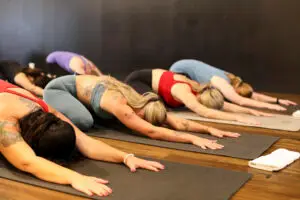
In class, you’re not just stretching. You’re giving your body a way to process what it’s been holding onto. A slow forward fold. A steady warrior. A pause in child’s pose where you realize you’ve been clenching your face all day.
Little by little, your attention shifts out of the mental loop and back into your body.
There’s Something Different About Practicing Together
Online classes have their place, but being in a room with other people hits differently.
You don’t have to think about what comes next. You don’t have to pause to switch the laundry or check your phone. You don’t have to manage anything for an hour.
You just get to be guided.
For a lot of people, that’s where the real exhale happens. You walk in, take your spot, and let someone else hold the structure for a while. No performance required.
If you’re curious what that could look like for you, you can explore the different classes at Ignite.
You May Not Leave With an Empty Mind
And that’s okay.
The goal isn’t to become someone who never feels stressed or distracted. It’s to create a little more space between you and the noise.
After class, your inbox will still be there. Dinner still needs to happen. Life keeps moving.
But maybe your shoulders feel a little softer. Your breath is a little steadier. There’s a bit more room before the next thing demands your attention.
That matters.
Setting It Down Is a Practice
Yoga for stress relief isn’t about escaping your life. It’s about coming back to it with a little more steadiness.
Some days, the shift is obvious. Other days, it’s subtle. You might not notice it until you’re a little less reactive in a conversation, a little more patient in traffic, or able to take one full breath before jumping into the next thing.
That’s the practice doing its quiet work.
At Ignite Yoga, you don’t have to show up calm, flexible, or perfectly focused. You just have to show up, roll out your mat, and let the practice meet you where you are.
If that sounds like what you need right now, you can check out the class schedule here and find a time that fits your day.